

Eigenlayer 2026: the new limits to account for
By 2026, EigenLayer has shifted from a novel restaking experiment to a critical infrastructure layer with strict operational constraints. The protocol no longer relies solely on the trust of early adopters; it now enforces tighter security assumptions through its Actively Validated Services (AVSs). For builders and stakers, this means the "marketplace for trust" operates with far less margin for error than in previous years.
The primary constraint is the alignment of economic security. Stakers must now carefully evaluate the slashing conditions of each AVS they support. An AVS that demands high uptime or specific computational resources introduces new risks that did not exist when securing only the Ethereum base layer. If an AVS fails, the staker’s deposited ETH can be slashed, making due diligence on each service provider essential.
This evolution has also changed the yield landscape. Restaking rewards are no longer uniform; they are priced by the market based on the perceived risk of each AVS. High-yield opportunities often correlate with higher technical complexity or lower decentralization. Stakers must weigh these potential returns against the risk of smart contract vulnerabilities or slashing events. The protocol’s design ensures that security is not just a collective good but a commodity that must be actively managed and monitored.
For the average user, this means moving beyond passive staking. Engaging with EigenLayer in 2026 requires an understanding of the specific AVSs being secured and the technical requirements they impose. The barrier to entry has risen, but so has the potential for meaningful contribution to the broader Ethereum ecosystem.
Eigenlayer 2026 choices that change the plan
EigenLayer has evolved from a simple restaking protocol into a broader "verifiable cloud" infrastructure. This shift introduces new variables for anyone evaluating the protocol's viability in 2026. The dominant provider now holds roughly 94% of the restaking market and over $15 billion in total value locked, but this scale comes with specific operational tradeoffs that differ from traditional staking.
When comparing EigenLayer against other Ethereum staking options, you must weigh capital efficiency against complexity. Traditional stakers lock ETH for yield with minimal ongoing management. EigenLayer allows that same capital to secure Additional Verifiable Services (AVSs), effectively multiplying yield potential. However, this requires active participation, understanding slashing conditions, and monitoring multiple service contracts. The convenience premium of standard staking is replaced by the yield potential of active restaking.
The following table breaks down the primary tradeoffs to consider when allocating capital in the current market.
| Factor | EigenLayer | Standard Staking |
|---|---|---|
| Capital Efficiency | High (multi-service) | Low (single-purpose) |
| Yield Potential | Variable (AVS-dependent) | Stable (ETH rewards) |
| Slashing Risk | Elevated (cross-service) | Low (protocol-only) |
| Management Effort | High (active monitoring) | Low (passive) |
| Liquidity | Medium (LST-based) | High (LST-based) |
Market Context
The financial landscape for restaking is shifting. As EigenLayer expands into verifiable cloud services, the EIGEN token's utility is increasingly tied to the performance of these new AVSs rather than just ETH staking yields. This creates a more complex price discovery mechanism for investors.
The price action for EIGEN reflects this transition. Investors are no longer just betting on Ethereum's security; they are betting on the demand for EigenLayer's computational verification services. This dual dependency means that market volatility can be amplified by both crypto-wide trends and specific AVS adoption rates.
Choose the Next Step for EigenLayer V2
EigenLayer V2 has shifted from a simple restaking mechanism to a modular trust marketplace. For builders and operators, the protocol is now a collection of distinct primitives. You need to decide which layer of security and infrastructure your project actually requires.
The choice depends on whether you need shared security for a new application, low-latency data availability, or a combination of both. Here is the practical framework for selecting the right path.
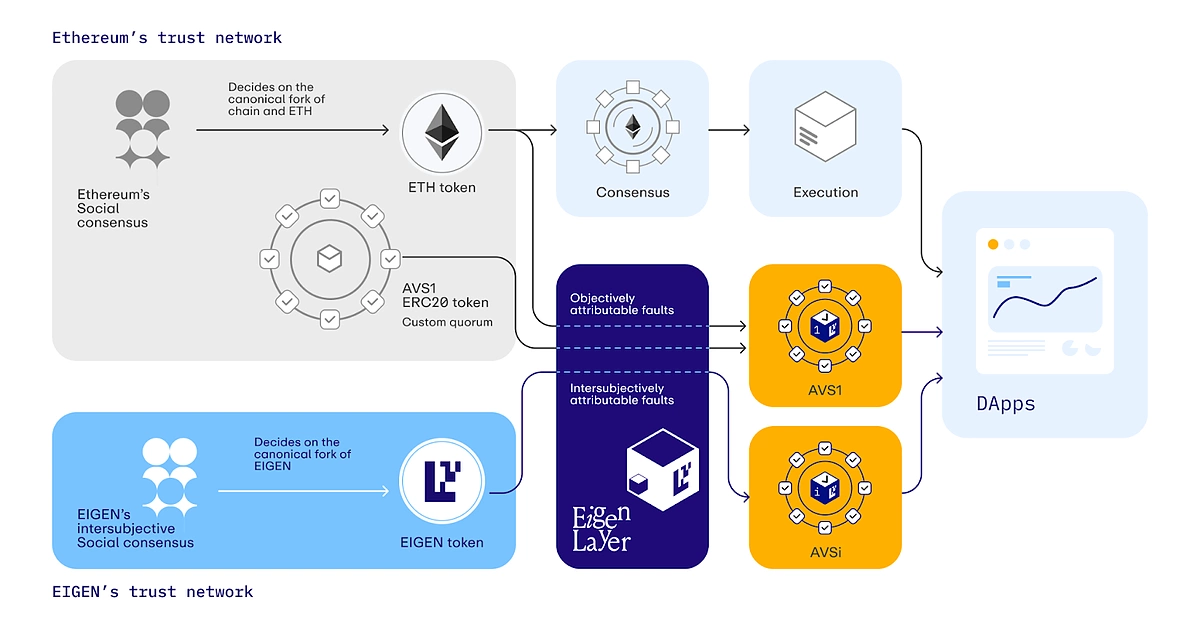
Active Validator Services (AVSs) are the core of EigenLayer V2. If your project requires decentralized oracle feeds, bridge validation, or MEV protection, an AVS is the primary tool. The decision starts with whether your trust assumptions can be satisfied by existing AVSs like EigenDA or specialized oracle networks, or if you must build a custom one. Custom AVSs offer flexibility but require significant operational overhead to manage slashable stakes.
EigenDA is the default data availability solution for most builders entering the ecosystem. It uses restaked ETH to provide cheap, scalable data blocks for rollups and applications. If your primary bottleneck is data cost or throughput, EigenDA is the standard choice. However, if your application relies on existing L2 data availability or has specific compliance needs that conflict with EigenDA’s architecture, you may need to stick with Layer 2 native solutions or explore alternative DA layers.
Before launching a new AVS or DA contract, check if your needs are already met by integrating with established protocols. Many projects simply need to plug into existing EigenLayer-powered oracles or bridges. This integration path is faster and carries lower smart contract risk. Use the EigenLayer dashboard to verify the health and uptime of current AVSs before committing your own capital to secure a new service.
| Primary Need | Recommended Step |
|---|---|
| Decentralized Security | Custom or Existing AVS |
| Cheap Data Storage | EigenDA |
| Quick Launch | Integrate Existing AVS |
Watch out for weak restaking options
Not every Actively Validated Service (AVS) on EigenLayer V2 is built to last. The "marketplace for trust" model lowers the barrier to entry, which means you will encounter projects with thin security budgets or vague utility. Before committing restaked ETH, check the AVS's slashing conditions and economic security depth. If an AVS relies solely on the shared security of Ethereum without its own robust incentive layer, it may fail to attract sufficient validators, leaving your assets exposed to unnecessary risk.
Be wary of AVSs that promise high yields by simply rebranding existing staking services. Restaking is not a yield booster; it is a mechanism for securing additional infrastructure. If the service does not provide a clear, tangible benefit beyond the base Ethereum staking reward, the complexity and risk are not worth it. Look for AVSs that solve real problems, such as decentralized data availability or oracle networks, rather than those offering abstract financial products.
Also, avoid projects with unclear governance or opaque code audits. The EigenLayer ecosystem is still evolving, and smart contract risks are real. Ensure the AVS has undergone rigorous third-party security reviews and has a transparent governance structure. If the team cannot clearly explain how their service contributes to the broader Ethereum ecosystem or how slashing is enforced, it is a red flag. Stick to well-established AVSs with a track record of reliability and security.
Eigenlayer 2026: what to check next
Is EigenLayer still just a restaking protocol? No. In June 2025, the project rebranded to EigenCloud, expanding from simple Ethereum restaking into a broader "verifiable cloud" infrastructure. It now functions as a marketplace for trust, allowing builders to tap into staked ETH to secure new services beyond the base Ethereum layer.
What is the current market position for EigenLayer? EigenCloud dominates the sector, holding roughly 94% of the restaking market with over $15 billion in total value locked (TVL) as of 2026. This concentration makes it the primary gateway for accessing restaking yields and AVS (Actively Validated Services) participation.
How does the EIGEN token fit into 2026? The EIGEN token serves as the governance and utility asset for the EigenCloud ecosystem. Recent developments include the launch of aligned tokens like $ALIGN, which integrate with EigenCloud's infrastructure, further embedding EIGEN into the broader Ethereum staking and infrastructure stack.
What are the main risks of restaking in 2026? Restaking introduces complex slashing risks where operators can lose staked ETH if they fail to perform their duties across multiple services. While the protocol offers higher yields than standard staking, the technical complexity and potential for cascading failures require careful due diligence on the specific AVS being secured.
No comments yet. Be the first to share your thoughts!