
Eigenlayer in 2026: the restaking limits to account for
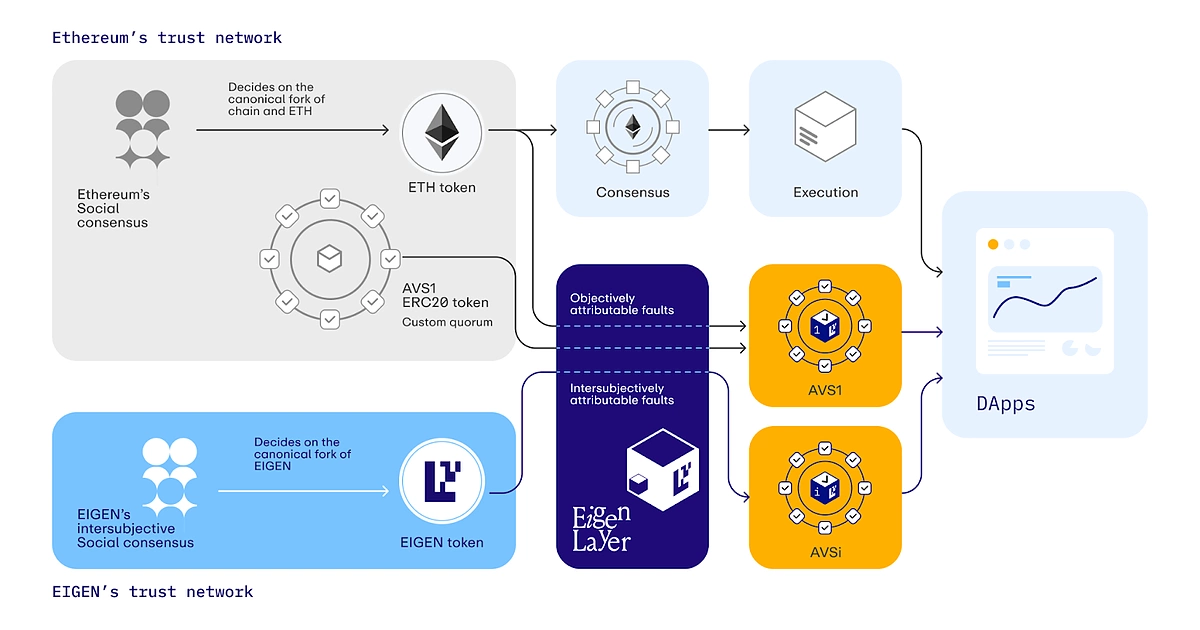
By 2026, EigenLayer has moved beyond its initial promise of securing Ethereum itself to become the primary trust layer for new L1s and AI infrastructure. The protocol functions as a marketplace for trust, allowing operators to reuse their staked ETH and liquid staking tokens to provide security to other networks. This evolution has created a complex web of dependencies where the security of one chain is often tied to the health of another.
The "restaking constraint" refers to the risk that arises when multiple protocols rely on the same set of operators. If a major operator fails or is slashed, the impact ripples across every network it secures. This interconnectedness means that EigenLayer is no longer just an Ethereum feature; it is a foundational component of the broader crypto economy. Understanding this constraint is essential for anyone evaluating the risk profile of modern L1s and AI projects.
Operators must now navigate a more rigorous environment. Slashing conditions have expanded beyond simple double-signing to include failures in AI inference or data availability proofs. This increases the technical bar for entry and forces operators to diversify their validator setups. For investors, this means that the value of the EIGEN token is increasingly tied to the actual utility and security provided by these diverse networks, rather than speculative hype.
Evaluating EigenLayer Tradeoffs in 2026
EigenLayer has evolved from a pure Ethereum restaking protocol into a broader "marketplace for trust" that secures new L1s and AI infrastructures. In 2026, holding roughly 94% of the restaking market with over $15 billion in total value locked, it remains the dominant player, but this dominance comes with specific tradeoffs. When evaluating EigenLayer, you must weigh the enhanced capital efficiency against the complexity of slashing risks and the technical demands of running restaked services.
The primary benefit is capital efficiency. By restaking ETH or liquid staking tokens (LSTs), validators can secure multiple networks simultaneously without deploying additional hardware. This creates a deeper security pool for new projects, from AI data markets to modular blockchains. However, this convenience introduces complexity. If a restaked service fails or acts maliciously, your ETH is at risk of slashing. You are effectively underwriting the security of other protocols with your stake, which requires rigorous due diligence on the Actively Validated Services (AVSs) you choose to support.
To help you compare these factors, the table below breaks down the core tradeoffs of participating in the EigenLayer ecosystem in 2026.
| Factor | Benefit | Risk/Tradeoff |
|---|---|---|
| Capital Efficiency | Secures multiple networks with one stake | Complexity in managing multiple slashing conditions |
| Network Security | Deepens security for new L1s and AI infra | Centralization pressure if large pools dominate |
| Yield Potential | Additional yield from AVS incentives | Variable rewards; no guaranteed minimum APY |
| Technical Barrier | Access to cutting-edge decentralized infra | Requires robust node infrastructure and monitoring |
Before committing capital, consider your risk tolerance. Restaking is not passive income; it is an active security commitment. Ensure you understand the slashing conditions of each AVS and have the technical capability to respond to network events. The ecosystem is growing rapidly, but so are the potential pitfalls.
Choose the next step
EigenLayer works best as a clear sequence: define the constraint, compare the realistic options, test the tradeoff, and choose the path with the fewest hidden costs. That order keeps the advice usable instead of decorative. After each step, pause long enough to check whether the recommendation still fits the reader's actual situation. If it depends on perfect timing, unusual access, or a best-case budget, include a simpler fallback.

Spotting Misleading Claims and Weak Options
As EigenLayer expands beyond Ethereum to secure new L1s and AI infrastructure, the narrative has shifted from experimental promise to market reality. This evolution brings a wave of projects claiming "EigenLayer-native" security or restaking capabilities. For investors and builders, distinguishing between robust infrastructure and marketing fluff is critical. The primary keyword cluster here focuses on identifying EigenLayer risks and evaluating the actual utility of these new integrations.
Many new L1s and AI protocols advertise "restaking support" to boost their security metrics. However, not all implementations are equal. Some projects merely wrap existing ETH staking without adding meaningful cryptographic guarantees or slashing conditions. Others may rely on EigenLayer's shared security but lack the economic incentives to keep operators honest. When evaluating a project, look for explicit mentions of EIP-7002 activation and clear slashing clauses in their documentation. If a project vague about how their "trust" is secured, it is likely a weak option.
Another common mistake is conflating EigenLayer's restaking with traditional staking. Restaking allows you to reuse the same ETH to secure multiple networks simultaneously. This creates a "marketplace for trust," but it also introduces correlated risk. If one secured network fails or suffers a bridge exploit, your restaked ETH could be slashed across all networks. Do not assume that more secured networks automatically mean safer investments. The security of the entire ecosystem is only as strong as its weakest link.
To navigate this landscape, use the following checklist when reviewing new EigenLayer-integrated projects:
- Check the Slashing Conditions: Ensure the project has transparent, on-chain slashing mechanisms. Vague promises of "community governance" are insufficient.
- Verify the Integration Depth: Does the project use EigenLayer for core consensus security, or just as a marketing badge? Core integration is more significant.
- Assess the Economic Incentives: Are operators properly incentivized to act honestly? Weak incentives lead to centralization or negligence.
- Review the Team's Technical Credibility: Look for audited smart contracts and a history of secure deployments. Avoid projects with anonymous teams and unaudited code.
By focusing on these concrete checks, you can avoid the weak options and misleading claims that plague the early stages of EigenLayer's expansion. The future of restaking is promising, but it requires careful due diligence to separate genuine innovation from hype.
EigenLayer in 2026: Common Questions Answered
As the EigenLayer ecosystem matures, practical concerns around token economics, market positioning, and underlying technology clarity drive reader interest. Below are direct answers to the most frequent questions regarding the protocol’s current state and future outlook.
What is EigenLayer and what does it do?
EigenLayer is an Ethereum restaking protocol that allows staked ETH and liquid staking tokens to secure additional networks beyond Ethereum itself. Rather than securing only one chain, your staked assets act as a "marketplace for trust," providing security to new L1s, L2s, and AI infrastructure projects. In 2026, the protocol has evolved into EigenCloud, expanding its utility from simple restaking to a broader "verifiable cloud" for decentralized compute.
What is the price prediction for EigenLayer coin in the future?
Current market analysis suggests that if the EIGEN token appreciates at a steady rate of 5% annually, its price could reach approximately $0.23 by 2027. Long-term projections indicate further growth to $0.28 by 2031, $0.36 by 2036, and $0.46 by 2041. These figures are based on conservative growth models and should be viewed as estimates rather than guarantees, as crypto markets remain highly volatile.
Can you still mine Ethereum in 2026?
No. Ethereum transitioned to a Proof-of-Stake (PoS) consensus mechanism with the Merge in 2022. Mining requires specialized hardware to solve cryptographic puzzles, which is no longer part of Ethereum’s security model. In 2026, Ethereum security is provided by validators who stake ETH, not by miners. While you cannot mine ETH, you can participate in the network by staking ETH through EigenLayer or other validators.
How high will ETH go in 2026?
Ethereum’s price trajectory in 2026 is influenced by broader macroeconomic trends, regulatory developments, and the success of its Layer 2 ecosystem. While EigenLayer’s dominance in restaking (holding roughly 94% of the market) supports network utility, ETH’s price remains subject to standard market forces. Investors should monitor on-chain activity, institutional adoption, and global liquidity conditions rather than relying on fixed price targets.
No comments yet. Be the first to share your thoughts!