

In 2025, the landscape of Ethereum security is being fundamentally reshaped by the convergence of cross-chain restaking and cryptoeconomic accountability. The partnership between EigenCloud’s EigenZero and LayerZero’s interoperability protocol marks a new era for decentralized finance, where economic security extends seamlessly across multiple blockchains. With Ethereum (ETH) trading at $3,151.02, up marginally in the last 24 hours, these innovations are not just theoretical, they’re underpinning billions of dollars in value and real-world applications.
How EigenZero Redefines Cross-Chain Security
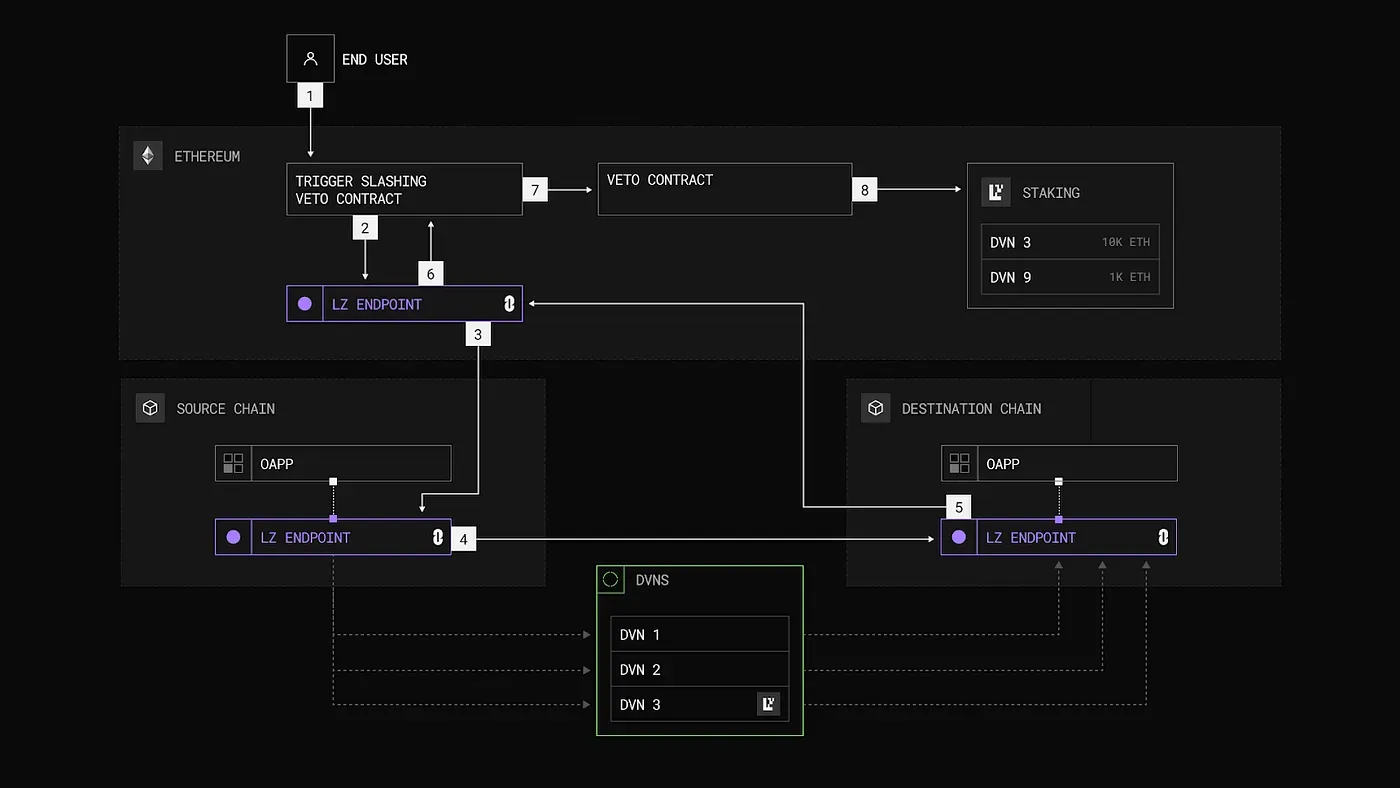
At its core, EigenZero is a Distributed Validator Network (DVN) engineered to bring Ethereum’s robust economic security to the world of cross-chain messaging. Built atop EigenCloud’s pioneering restaking infrastructure, EigenZero leverages slashing-based accountability, a model where validators put significant capital at risk to guarantee honest behavior.
The mechanics are straightforward yet powerful: participants must stake at least $5 million in ZRO tokens. If a validator incorrectly verifies a cross-chain message or fails to meet performance standards set by Actively Validated Services (AVSs), they face immediate financial penalties through slashing mechanisms. This creates strong incentives for accurate validation while aligning verifier interests with network integrity.
This approach is a leap beyond traditional cryptographic proofs or multi-sig bridges. By introducing slashing-enabled economic penalties for misbehavior, modeled after Optimism’s 11-day challenge period, EigenZero ensures that every cross-chain message is economically secured and verifiable on Ethereum’s mainnet.
The LayerZero Integration: Finality Across Chains
LayerZero, renowned for its full-chain interoperability protocol, has adopted Ethereum as its finality layer, an architectural decision that amplifies both trust and transparency in cross-chain operations. By anchoring message finality to Ethereum, LayerZero ensures that any transaction traversing its network inherits the same security guarantees as native ETH transfers.
This synergy means that applications can verify messages across chains with measurable confidence, knowing that validators are economically incentivized to act honestly under threat of slashing. As a result, DeFi protocols can safely offer services like lending, swaps, or synthetic assets across multiple blockchains without compromising on security or user trust.
The impact is already quantifiable: as of mid-2025, EigenLayer secures over $7 billion in restaked assets, spanning 39 actively validated services. This not only demonstrates market confidence but also signals how quickly cryptoeconomic models are becoming foundational to blockchain infrastructure.
Ethereum (ETH) Price Prediction Table: Post-EigenZero Adoption (2026-2031)
Professional forecast considering EigenZero, LayerZero, and cross-chain restaking advancements
| Year | Minimum Price (Bearish) | Average Price (Base Case) | Maximum Price (Bullish) | Year-over-Year Change (Avg) | Key Market Scenario |
|---|---|---|---|---|---|
| 2026 | $2,650 | $3,700 | $4,800 | +17% | Stabilization after EigenZero integration; increased institutional interest |
| 2027 | $2,900 | $4,250 | $5,700 | +15% | Layer 2 adoption accelerates, capital efficiency drives network usage |
| 2028 | $3,300 | $5,100 | $7,000 | +20% | Global regulatory clarity, cross-chain DeFi expansion |
| 2029 | $3,800 | $6,000 | $8,800 | +18% | Mainstream adoption, ETH as backbone for multi-chain security |
| 2030 | $4,400 | $7,150 | $10,500 | +19% | Scaling solutions mature, ETH dominates Web3 infrastructure |
| 2031 | $5,100 | $8,350 | $12,000 | +17% | Interoperability standardization, ETH entrenched as security protocol |
Price Prediction Summary
Ethereum's price outlook from 2026 to 2031 remains robust, propelled by transformative security enhancements via EigenZero and LayerZero. The cross-chain restaking paradigm is expected to solidify Ethereum's role as a foundational security layer for the blockchain ecosystem, attracting further institutional and developer adoption. While volatility and regulatory uncertainties may produce short-term downside risk, the long-term trajectory points to sustained growth, especially as interoperability and capital efficiency improve.
Key Factors Affecting Ethereum Price
- Widespread adoption of EigenZero and cross-chain restaking mechanisms
- Continued growth and innovation in Layer 2 and cross-chain protocols
- Institutional participation driven by enhanced security and accountability
- Global regulatory developments impacting crypto markets
- Competition from alternative smart contract platforms
- Market cycles (bull/bear phases) and macroeconomic factors
- Liquidity flows and DeFi market expansion
- Potential for disruptive technological upgrades (e.g., sharding, ZK-proofs)
Disclaimer: Cryptocurrency price predictions are speculative and based on current market analysis. Actual prices may vary significantly due to market volatility, regulatory changes, and other factors. Always do your own research before making investment decisions.
Restaking Meets Capital Efficiency: The Rise of Native L2 Solutions
An equally important development is the introduction of native Layer 2 restaking solutions like weETH. Users can now mint weETH directly on Layer 2 networks, earning mainnet-equivalent rewards while benefiting from lower gas costs and increased scalability. This innovation enhances capital efficiency by allowing staked assets to secure multiple protocols simultaneously without fragmenting liquidity across chains.
The result? A more resilient and scalable ecosystem where validators earn diversified rewards streams while users enjoy seamless interoperability between chains, all underpinned by Ethereum’s economic security model.
Key Takeaways for Validators and Protocol Builders
- Cross-chain restaking via EigenZero enforces cryptoeconomic guarantees using real capital at risk.
- LayerZero leverages Ethereum's finality for secure multi-chain messaging.
- Native L2 restaking solutions like weETH optimize capital efficiency and scalability for all participants.
- Explore our deep dive into how EigenZero is redefining cross-chain security with crypto-economic verifier networks here.
Looking ahead, the interplay between EigenZero, LayerZero, and Ethereum’s evolving restaking ecosystem is setting new benchmarks for both security and usability. The real-world implications are profound: cross-chain DeFi protocols can now launch with confidence that their message verification is not just technically sound, but also economically enforced. This dual assurance is crucial as the total value locked (TVL) in restaked assets surpasses $7 billion, a figure that would have seemed ambitious just a year prior.
Yet, these advances are not without challenges. As highlighted by experts in recent market analyses, the introduction of slashing-based accountability brings new operational risks for validators. Market volatility in Q3 2025 has tested liquidity buffers and forced protocol designers to consider more robust risk mitigation strategies. Structured token incentives and insurance pools are emerging as essential tools to hedge against unforeseen slashing events, especially as validator roles become more complex across multiple chains.
For investors and protocol architects, this means due diligence is more important than ever. Understanding how economic penalties are triggered, what constitutes misbehavior under AVS definitions, and how restaked capital is managed on Layer 2s will be key differentiators in selecting sustainable projects.
The Road Ahead: Crypto Interoperability in 2025 and Beyond
The broader impact of cross-chain restaking extends well beyond Ethereum. As interoperability protocols like LayerZero continue to mature, we can expect even greater composability between EVM-compatible chains and non-EVM networks alike. This will unlock entirely new classes of decentralized applications, from unified liquidity markets to omnichain DAOs, that leverage cryptoeconomic guarantees as a baseline security primitive.
The success of EigenZero’s Distributed Validator Network model demonstrates that economic incentives aligned with transparent slashing policies create measurable trust. As adoption grows, we anticipate further integration with other major L1s and L2s seeking Ethereum-grade security without sacrificing speed or cost efficiency.
For those looking to participate, whether by staking $ZRO or $EIGEN tokens, operating AVSs, or building next-generation DeFi platforms, the time to engage with these frameworks is now. The paradigm shift toward cross-chain cryptoeconomic security is well underway, reshaping not only how value moves across blockchains but also how trust itself is engineered in decentralized systems.




No comments yet. Be the first to share your thoughts!