
EigenLayer restaking 2026 explained
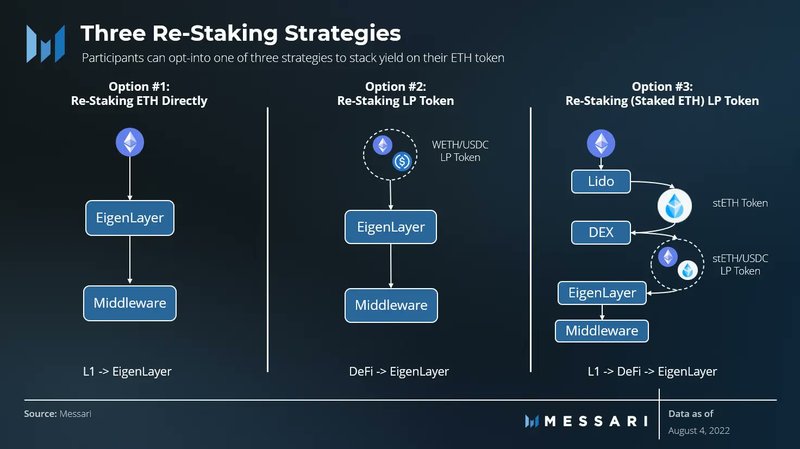
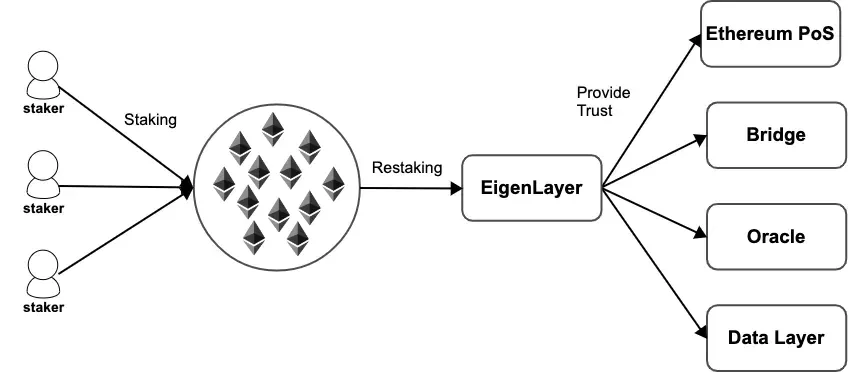
EigenLayer restaking 2026 represents a structural shift in how Ethereum validators generate yield. Introduced as a middleware layer, it allows validators to reuse their existing staked ETH to secure additional services, known as Actively Validated Services (AVS), rather than locking capital for a single network.
Standard staking involves locking ETH to secure the Ethereum consensus layer. Restaking takes that same security deposit and re-uses it to provide cryptographic guarantees to other protocols. This mechanism, often described as "shared security," effectively multiplies the utility of Ethereum's trust network without requiring validators to acquire additional assets.
The financial incentive is straightforward. By extending their security footprint, validators earn additional yield on top of the base Ethereum staking rewards. Current market conditions suggest average returns for restaking protocols range between 4% and 6%, depending on the specific AVS and market demand for security.
How AVS ecosystems drive new yields
Actively Validated Services (AVS) represent the primary mechanism for generating incremental yield in EigenLayer restaking 2026. While standard ETH staking rewards are determined by the base Ethereum protocol, AVS allow validators to secure additional networks and services, creating a distinct revenue stream. This model transforms staked capital from a passive income source into an active infrastructure provider.
By April 2026, EigenLayer had secured tens of billions of dollars in restaked assets across more than 100 AVS. These services range from decentralized oracle networks and data availability layers to specialized bridging protocols. Each AVS operates as a separate economic layer, requiring its own set of validators to maintain security and consensus. This fragmentation of trust allows capital to be monetized multiple times across different use cases.
The yield from AVS is not uniform; it depends on the specific service being secured, the demand for its output, and the competitive landscape of validators. Some AVS offer higher rewards to attract sufficient security, while others provide more stable, lower-yield returns based on established utility. This variety allows restakers to tailor their portfolios to their risk tolerance and yield expectations, moving beyond the single-variable model of traditional staking.
EIGEN/ETH Market Performance
EigenLayer Restaking vs. Liquid Staking Tokens
Liquid staking tokens (LSTs) and EigenLayer restaking serve different roles in a crypto portfolio. LSTs prioritize liquidity, allowing you to trade or use staked ETH in DeFi while earning baseline consensus rewards. EigenLayer restaking sacrifices some liquidity to secure additional protocols, known as Actively Validated Services (AVSs), in exchange for higher yield potential.
The tradeoff is straightforward: LSTs offer simplicity and flexibility, while restaking offers higher yields through shared security. However, restaking introduces complexity and new risk vectors, such as slashing conditions across multiple AVSs. For investors seeking to maximize returns from existing staked assets, EigenLayer restaking provides a mechanism to earn extra yield without locking up additional capital.
Side-by-Side Comparison
The table below contrasts the core mechanics and risk profiles of standard LSTs versus EigenLayer restaking.
| Feature | Liquid Staking (LST) | EigenLayer Restaking |
|---|---|---|
| Primary Goal | Liquidity & Baseline Yield | Shared Security & Higher Yield |
| Yield Source | Ethereum consensus rewards | Ethereum rewards + AVS incentives |
| Liquidity | High (tradable token) | Medium (locked during restaking) |
| Complexity | Low (one-click staking) | High (AVS selection & management) |
| Slashing Risk | Ethereum consensus only | Ethereum + AVS-specific penalties |
Slashing risks and security choices that change the plan
Restaking amplifies yield potential, but it also concentrates risk. When you restake ETH or liquid staking tokens through EigenLayer, you are not just securing the Ethereum network; you are extending that security to Actively Validated Services (AVSs). This creates a multi-layered liability. If an AVS fails or an operator acts maliciously, the consequences can extend back to your original staked assets.
The most immediate threat is slashing. Slashing occurs when an operator violates the protocol's rules, resulting in the forced destruction or lockup of their staked capital. In a restaking context, your ETH is shared across multiple services. If one of those services experiences a security breach or an operator is slashed for misconduct, your restaked assets are at risk. The severity depends on the specific slashing conditions defined by each AVS, but the potential for loss is real and significant.
Smart contract vulnerabilities add another layer of complexity. EigenLayer relies on complex code to manage the delegation of security and the distribution of rewards. Any bug or exploit in these contracts could lead to the loss of funds. While the protocol has undergone rigorous auditing, the attack surface is larger than standard Ethereum staking. Users must trust not only the Ethereum base layer but also the integrity of every AVS and the middleware contracts that facilitate restaking.
Warning: Slashing risks in EigenLayer restaking 2026 are non-trivial. Your capital is exposed to the security posture of every AVS you support. Careful operator selection and understanding the specific slashing conditions of each service are essential to mitigate these high-stakes risks.
The tradeoff is clear: higher yields come with higher potential for total loss. Unlike standard staking, where slashing is relatively rare and limited to the validator set, restaking introduces dependencies on third-party services. As EigenLayer continues to attract tens of billions in total value locked, the importance of robust security audits and transparent operator practices becomes paramount for the health of the ecosystem.
Choosing a Restaking Strategy in 2026
Selecting a restaking strategy in 2026 requires aligning your risk tolerance with the specific Actively Validated Services (AVS) you choose to support. Unlike simple staking, restaking introduces additional layers of complexity, primarily through smart contract risk and slashing conditions. Your approach should prioritize capital preservation while seeking yield from the diverse set of protocols built on EigenLayer.

The landscape of EigenLayer restaking 2026 is defined by the interplay between yield generation and security overhead. By carefully selecting operators and AVSs that match your financial goals, you can participate in securing the Ethereum ecosystem while managing the unique risks associated with restaking.
Frequently asked questions about restaking
What is EigenLayer restaking?
Restaking means using already-staked crypto — usually ETH or a liquid staking token — to secure additional networks or services beyond Ethereum itself. Normally, staking ETH means helping secure Ethereum. Validators lock ETH, follow consensus rules, and earn staking rewards. EigenLayer allows that same stake to be reused to provide security to other protocols, known as Actively Validated Services (AVS), without requiring additional capital to be locked up. This mechanism lets the network scale its security budget more efficiently than traditional models where each new chain requires its own independent validator set.
Can you still mine Ethereum in 2026?
You cannot mine Ethereum in 2026. Mining ended permanently on September 15, 2022, when the network transitioned to Proof of Stake. Before The Merge, the timeline depended on hardware and network difficulty, but the shift to Proof of Stake rendered mining hardware obsolete for Ethereum. Today, securing the network requires staking ETH rather than solving computational puzzles, which has fundamentally changed how participants earn rewards and contribute to network security.
What are the main risks of restaking ETH?
The primary risk in restaking is slashing, where validators lose a portion of their staked ETH for malicious behavior or downtime. Because restaking amplifies the value of the stake across multiple protocols, a single slashing event can impact all connected AVSs simultaneously. Additionally, smart contract risk exists within the EigenLayer infrastructure and individual AVSs. If a protocol has vulnerabilities, funds could be at risk beyond just the consensus-layer penalties. Participants must carefully evaluate the security posture of every AVS they support.
How much yield can I expect from restaking?
Current APY rates for restaking typically range between 4% and 6%, depending on market conditions and the specific AVSs selected. This yield combines the base Ethereum staking reward with additional incentives paid by the AVSs for the security provided. Yields fluctuate based on demand for security services and the total amount of ETH restaked. While higher yields may appear in new or niche AVSs, they often come with higher risk profiles or less mature infrastructure.
No comments yet. Be the first to share your thoughts!