

EigenLayer restaking 2026 market dominance
EigenLayer has cemented its position as the dominant restaking protocol on Ethereum throughout 2026. By functioning as a "marketplace for trust," it allows staked ETH to provide cryptographic security for new protocols, known as Actively Validated Services (AVSs), beyond the base layer itself. This structural shift has concentrated significant capital under its umbrella, creating a centralized node of liquidity for the broader ecosystem.
Current data places EigenLayer's total value locked (TVL) between $15 billion and $19.7 billion, depending on the metric source. More importantly, it commands approximately 94% of the restaking market share. This near-monopoly status means that a vast majority of restaked assets are routed through its operators, making its security model a critical infrastructure piece for Ethereum's expansion.
The protocol's scale is not merely a reflection of capital accumulation but of its evolving utility. As it transitions from pure restaking to offering verifiable cloud computing resources, it attracts institutional-grade validators who require robust infrastructure. This dual role as both a security layer and a compute provider has solidified its hold on the market, leaving little room for competing protocols to gain significant traction.
How restaking mechanics evolved in 2026
EigenLayer entered 2026 as the dominant restaking protocol on Ethereum, holding roughly 94% of the restaking market and over $15 billion in total value locked. This market dominance was not static; it was driven by a fundamental architectural shift from simple yield aggregation to a more complex, modular security model known as "Verifiable Cloud."
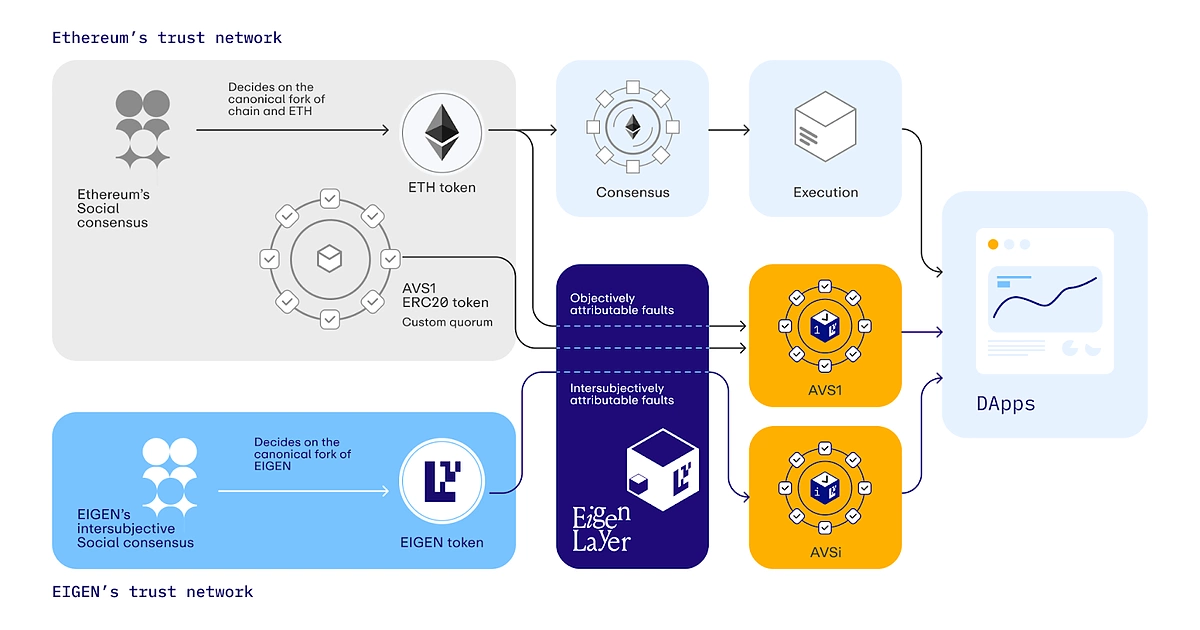
At its core, restaking enables stakers to reuse their Native ETH or Liquid Staking Tokens (LST) to provide cryptographic security for protocols outside of Ethereum. In exchange, these "restakers" earn additional protocol fees and rewards. However, the mechanism for delivering this security has matured significantly. The protocol now functions as a marketplace for trust, connecting restakers and operators with Autonomous Verifiable Services (AVSs).
AVSs are specialized services that require specific validation logic beyond standard Ethereum block finality. By integrating AVSs, EigenLayer allows staked ETH to secure diverse infrastructure needs, such as cross-chain bridges, data availability layers, or decentralized oracle networks. This integration transforms staked ETH from a passive yield asset into an active security resource for the broader Web3 ecosystem.
The evolution toward Verifiable Cloud emphasizes modularity. Operators can now choose which AVSs to support, allowing for a more granular distribution of risk and reward. While EigenLayer has implemented safeguards like unique stake and opt-in slashing, the complexity of securing multiple parallel services introduces new structural risks that investors must evaluate alongside yield potential.
Security audits and risk mitigation strategies
EigenLayer’s architecture introduces a layer of complexity that standard staking does not carry. When you restake ETH, you are not just securing the Ethereum consensus layer; you are simultaneously providing cryptographic security to multiple AVSs. This shared security model amplifies yield potential, but it also concentrates risk. A failure in one AVS or a smart contract vulnerability in the EigenLayer core can trigger cascading consequences for the entire restaking ecosystem.
The primary mechanism for risk management is the "opt-in" nature of AVS participation. Unlike native Ethereum staking, where validators are bound to the protocol’s core rules, restakers must explicitly choose which AVSs to secure. This design allows operators and restakers to assess the technical maturity and audit status of each service before committing capital. However, this choice requires diligent due diligence. If an AVS you have opted into suffers a slashing event due to operator misbehavior or a bug, your restaked ETH is subject to penalties. Understanding these slashing conditions is not optional—it is the foundation of safe participation.
To mitigate these risks, EigenLayer has implemented structural safeguards such as Unique Stake. This feature ensures that the same stake cannot be used to secure multiple conflicting AVSs simultaneously, reducing the attack surface for double-signing or equivocation attacks. Additionally, operator-level control allows validators to set strict limits on which services they support, preventing accidental exposure to high-risk protocols. These measures are critical, but they do not eliminate the possibility of smart contract exploits or oracle failures.
Recent security audits by firms such as Trail of Bits and OpenZeppelin have identified potential vectors for attack, particularly in the complex interactions between the EigenLayer contract and third-party AVSs. While no system is immune to bugs, the transparency of these audits allows the community to monitor progress. Investors should prioritize AVSs that have undergone rigorous, public audits and have established bug bounty programs. The landscape of restaking security is evolving rapidly, and staying informed about audit findings is essential for protecting your capital.
Comparing LRT yield profiles and risk structures
Liquid Restaking Tokens (LRTs) have fragmented the EigenLayer ecosystem, offering validators and restakers different trade-offs between yield generation and security exposure. While EigenLayer itself serves as the foundational marketplace for AVSs, the LRT layer introduces intermediate protocols that bundle security, often taking a cut of the rewards in exchange for liquidity and ease of use.
Choosing an LRT provider requires analyzing three core metrics: the base Ethereum staking yield, the additional AVS rewards generated, and the protocol’s specific risk profile, including slashing protection mechanisms and smart contract audit history. The total value locked (TVL) across these protocols currently stands at approximately $19.7 billion, indicating significant market participation but also concentrated risk if a major provider fails [src-serp-4].
The following table compares key LRT protocols based on their structural yield components and risk characteristics. Note that AVS rewards are variable and depend on network demand, so historical yields may not reflect future performance.
| Protocol | Primary Yield Source | Risk Profile | Liquidity Mechanism |
|---|---|---|---|
| Ether.fi (eETH) | ETH Staking + AVS Fees | Moderate (Multi-Operator) | High (Deep DEX Pools) |
| Renzo (ezETH) | ETH Staking + AVS Fees | Moderate (Automated Routing) | High (DeFi Integrations) |
| Puffer (pufETH) | ETH Staking + AVS Fees | Low (Slashing Insurance) | Medium (Protocol-Backed) |
| Karak (kETH) | ETH Staking + AVS Fees | Low (Modular Security) | Medium (Growing Ecosystem) |
Validators should note that higher yields often correlate with exposure to less audited AVS contracts or more complex smart contract architectures. For instance, protocols offering slashing insurance may appear safer, but they often pass the risk to a central treasury or insurance pool, which introduces counterparty risk. Always verify the latest audit reports from the protocol’s official documentation before committing capital [src-serp-8].
Validator Checklist for Safe Restaking
Participating in EigenLayer requires treating operational risk with the same rigor as financial risk. Before opting into any AVS, validators must execute a structured security audit of both the protocol and the operator infrastructure. This checklist outlines the essential steps to mitigate slashing exposure and ensure sustainable yield.
Only engage with AVSs that have undergone independent security audits from reputable firms. Review the audit reports for critical vulnerabilities and confirm that identified issues have been patched. Prioritize protocols with a transparent history of responsible disclosure and active bug bounty programs.

Analyze the specific slashing conditions for each AVS. Understand exactly which validator actions trigger penalties and the severity of the economic loss. Ensure you have the technical capability to monitor and avoid these conditions in real-time.
Evaluate the operator’s track record, including uptime, past slashing incidents, and community feedback. Choose operators with a proven history of reliable performance and transparent communication. Avoid operators with unverified claims or lack of public accountability.
Do not allocate all restaked capital to a single AVS. Spread exposure across multiple protocols to reduce the impact of a potential failure in any one service. This diversification helps protect your stake from systemic risks specific to individual projects.
Stay informed about governance proposals and protocol upgrades that may alter slashing conditions or reward structures. Participate in governance decisions that affect your security posture and ensure you understand the implications of any changes before they take effect.
Frequently asked questions about EigenLayer
What is restaking on EigenLayer?
Restaking allows staked ETH to secure additional protocols, known as Actively Validated Services (AVSs), rather than just the Ethereum base layer. This mechanism creates a marketplace for trust where restakers earn fees and rewards from multiple sources simultaneously while providing cryptographic security to new projects.
Is EigenLayer safe for stakers?
EigenLayer implements safeguards such as Unique Stake and opt-in slashing to mitigate risk, but it is not risk-free. Because restaked ETH can be slashed for misbehavior by AVSs, participants face higher exposure than standard Ethereum staking. Security depends heavily on the specific AVSs selected and the operator's track record.
Is EigenLayer built on Ethereum?
Yes, EigenLayer is a protocol built directly on Ethereum. It functions as a middleware layer that leverages Ethereum's existing staked ETH to bootstrap security for other decentralized systems. This integration allows Ethereum stakers to extend their capital efficiency across the broader Web3 ecosystem.
No comments yet. Be the first to share your thoughts!