
Restaked security enters 2026
The narrative around EigenLayer has shifted from speculative hype to functional infrastructure. In 2026, restaking is no longer a theoretical experiment but a stable pillar of Ethereum’s security model. The protocol has matured, moving past the volatile growth phases of 2025 to establish a reliable foundation for decentralized services.
The most significant indicator of this stability is the Total Value Locked (TVL). EigenLayer now consistently holds over $15 billion in staked assets. This capital depth provides a robust buffer against market fluctuations and signals strong institutional and retail confidence in the restaking mechanism. It is not just a measure of wealth, but a measure of trust in the underlying smart contracts and economic incentives.
Alongside TVL growth, the deployment of Autonomous Verifiable Services (AVS) has expanded significantly. These services leverage the shared security of Ethereum to offer specialized verification for off-chain operations. The ecosystem now supports a diverse range of AVS, from oracle networks to decentralized compute providers, demonstrating the versatility of the restaking model.
This transition from hype to utility marks a critical milestone. Restaked security is no longer just about earning yield; it is about securing the broader decentralized infrastructure. As the network continues to upgrade and integrate new services, EigenLayer remains a central node in the evolving landscape of crypto economics.
How AVSs Use Restaked Security
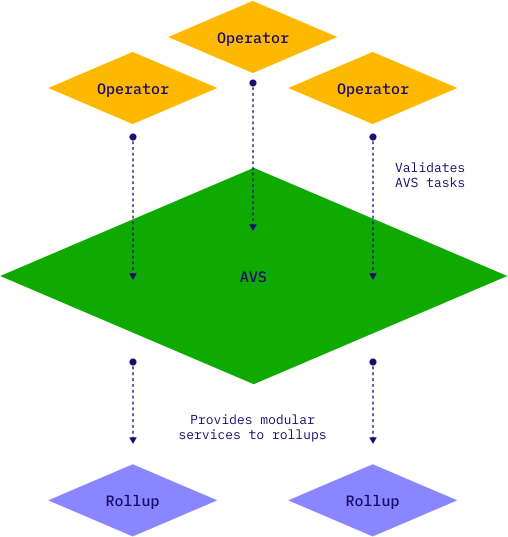
Autonomous Verifiable Services (AVS) transform Ethereum’s restaking infrastructure from a passive security layer into an active, programmable utility. Unlike standard Ethereum validators that only secure the base layer, an AVS is a decentralized service that leverages the Ethereum network to perform specific, custom verification tasks. This architecture allows developers to build specialized protocols—ranging from data availability layers to cross-chain bridges—without needing to bootstrap their own validator sets.
The mechanism operates through a shared security pool. Operators who have restaked ETH on EigenLayer commit their stake to secure multiple services simultaneously. When an AVS requires verification, it issues tasks to these operators. The network then uses cryptographic proofs to verify that the operators have correctly performed the work. If the majority of the restaked stake agrees on the outcome, the AVS’s state is finalized. This creates a modular security model where the cost of attacking an AVS is tied to the total value of restaked ETH, not just the capital locked within the AVS itself.
This shared security model introduces a unique risk profile. Because operators stake the same capital across multiple AVSs, a failure or malicious act in one service can trigger slashing conditions that impact the operator’s entire portfolio. This interdependence means that the health of individual AVSs is inextricably linked to the broader Ethereum ecosystem. As the number of AVSs grows, the concentration of restaked assets increases, making the underlying asset’s performance a critical indicator of network stability.
The following chart illustrates the price action of Ethereum, the foundational asset securing these services. Understanding ETH’s volatility is essential, as any significant price drop can reduce the total value secured, potentially altering the economic incentives for AVS operators and the security assumptions of the protocols they support.
Key AVS categories in 2026
The EigenLayer ecosystem has expanded beyond simple restaking into specialized Autonomous Verifiable Services (AVS). These services allow developers to build custom verification layers on top of Ethereum’s shared security, creating a diverse range of infrastructure. The current landscape is defined by three primary categories: oracles, data availability networks, and bridges.
| Category | Primary Function | Security Model | Maturity |
|---|---|---|---|
| Oracles | Feeding external data to smart contracts | Slashing for false data reporting | High |
| Data Availability | Storing and verifying transaction data | Cryptographic proofs and slashing | Medium-High |
| Bridges | Transferring assets between chains | Multi-sig and validator slashing | Medium |
Oracle AVSs, such as Chainlink’s CCIP or Pyth Network’s extensions, have reached high maturity. They provide critical price feeds and real-world data to DeFi protocols. The security model relies on slashing restakers who provide incorrect data, ensuring that the incentive to lie is outweighed by the financial penalty.
Data Availability (DA) networks are gaining traction as Ethereum’s rollup ecosystem grows. These AVSs ensure that transaction data is published and accessible, preventing data unavailability attacks. By using EigenLayer’s restaked ETH, DA networks can offer higher throughput and lower costs than Ethereum’s base layer, while still inheriting its security guarantees.
Bridges remain a high-risk category. While they enable cross-chain interoperability, they are frequent targets for exploits. AVS-based bridges use restaked security to monitor and validate cross-chain messages, reducing the reliance on trusted multi-sig wallets. This shift aims to make cross-chain transfers more secure, though the complexity of bridge mechanics requires careful risk assessment.
Enterprise adoption and reliability
Enterprise DeFi operates in a high-stakes environment where uptime and security are non-negotiable. For institutional participants, the appeal of EigenLayer’s restaked security lies in its ability to underwrite complex, high-value applications. However, this trust is not absolute; it is contingent on the robustness of the underlying infrastructure and the precision of its enforcement mechanisms. The margin for error is virtually zero, as the cost of failure extends beyond financial loss to reputational damage and regulatory scrutiny.
Slashing Conditions as Risk Management
At the core of enterprise confidence is the slashing condition—the automated penalty enforced when an operator fails to perform its duties or acts maliciously. For a bank or hedge fund integrating an Autonomous Verifiable Service (AVS), slashing is the ultimate insurance policy. It ensures that the economic stake backing the service is sufficient to cover potential losses, aligning the incentives of operators with the security needs of the enterprise.
Reliability extends beyond slashing. It requires a resilient operator network capable of handling peak loads without degradation. The recent Coinbase outage, triggered by an AWS thermal event, serves as a stark reminder of the fragility of centralized infrastructure. While EigenLayer distributes validation across decentralized operators, the dependency on cloud providers remains a single point of failure. Enterprises must evaluate not just the code, but the operational resilience of the operators backing their chosen AVS.
Real-World Usage Cases
The shift from theoretical security to real-world usage is evident in the growing number of AVSs designed for enterprise-grade tasks. These include decentralized oracle networks, zero-knowledge proof verification, and cross-chain bridge security. Each of these services requires a level of consistency and availability that matches traditional financial infrastructure. As these AVSs mature, they are becoming the backbone of a more robust and transparent financial system, offering enterprises a viable alternative to centralized solutions with enhanced security guarantees.
EigenLayer AVS 2026 FAQ
What is an AVS in EigenLayer?
An Autonomous Verifiable Service (AVS) is a decentralized application built on Ethereum that leverages EigenLayer’s restaked security. Unlike standard smart contracts, an AVS defines its own custom verification logic for off-chain operations, allowing developers to build specialized infrastructure like decentralized sequencers or oracles without launching a new blockchain.
Is Ethereum a viable investment in 2026?
Market data indicates Ethereum remains a foundational asset, processing over $50 billion in DeFi lending and $2.82 trillion in stablecoin transactions in late 2025. With the largest developer community in crypto and continuous protocol upgrades, the network’s utility continues to drive demand for ETH as both a governance token and gas medium.
Who created Ethereum?
Ethereum was co-founded by Vitalik Buterin, who envisioned it as a decentralized computing platform capable of supporting complex applications beyond simple value transfers. His work laid the groundwork for the modern decentralized finance (DeFi) ecosystem and the restaking infrastructure that powers services like EigenLayer.
No comments yet. Be the first to share your thoughts!