
EigenLayer 2026 ecosystem overview
EigenLayer has evolved from a novel restaking protocol into the foundational security layer for Ethereum’s modular infrastructure. By allowing validators to restake their ETH, the network provides shared security to a growing array of services, from oracle networks to decentralized sequencers. This architectural shift positions EigenLayer as a critical component in the broader crypto economy, where trust is increasingly derived from Ethereum’s base layer rather than isolated chains.
The market’s reception of this model is reflected in the trading behavior of the EIGEN token. Live data provides immediate context for the asset’s current valuation, which fluctuates based on total value secured and network adoption rates.
Looking at the broader technical picture, the token’s price action over the last day reveals short-term volatility typical of high-beta crypto assets. Traders are closely watching support levels as the ecosystem prepares for upcoming protocol upgrades and increased institutional participation.
For 2026, the consensus among analysts suggests a wide range of potential outcomes. Neutral predictions point to a price floor around €0.16, while more optimistic scenarios involving a full bull market and significant adoption could push valuations toward $10. These projections underscore the high-stakes nature of the restaking sector, where success depends on both technological reliability and sustained market demand.
ELIP-12 tokenomics overhaul
EigenLayer is preparing for a structural shift in mid-2026 with the introduction of ELIP-12. This proposal targets the core mechanics of the EIGEN token, aiming to stabilize the protocol’s economic model by addressing the current imbalance between supply and demand. The changes are not merely cosmetic; they represent a fundamental redesign of how value accrues to stakers and restakers.
At the heart of ELIP-12 is a new fee mechanism. The proposal introduces a 20% fee on specific protocol revenues, a significant increase from current rates. These fees will be directed into a treasury or used for buybacks, effectively reducing the circulating supply pressure. For investors, this shift transforms EIGEN from a purely utility-driven asset into one with tangible yield support.
The impact on yield is immediate. By capturing a portion of the growing restaking ecosystem’s revenue, the protocol creates a floor for token value. This mechanism is designed to reward long-term holders who provide security, aligning their interests with the network’s health. As restaking activity scales, the fee revenue should compound, offering a more predictable income stream for participants.
This overhaul is critical for EigenLayer’s long-term viability. Without such adjustments, the high inflation of EIGEN could continue to outpace demand, suppressing price appreciation. ELIP-12 offers a path to sustainability, ensuring that the protocol’s growth translates directly into value for its community. The market will be watching closely to see if these changes can withstand the scrutiny of a volatile crypto environment.
AVS expansion and operator upgrades
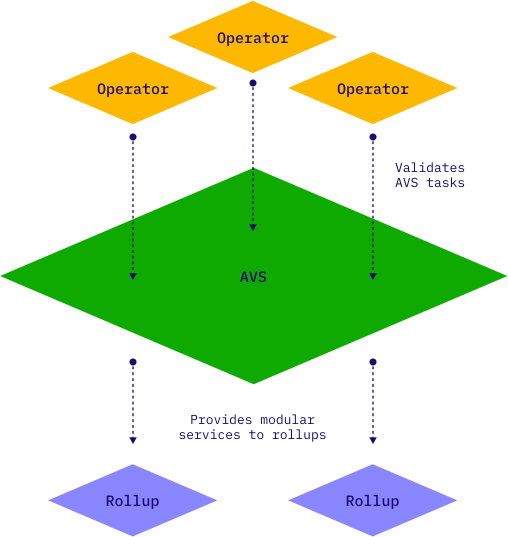
EigenLayer’s technical roadmap for 2026 centers on scaling the Active Verification Service (AVS) framework while upgrading the underlying operator infrastructure. The protocol is moving beyond simple Ethereum restaking to support specialized verification tasks, requiring operators to maintain higher performance standards. This shift transforms restaking from a passive yield mechanism into an active security provision layer, where operators must demonstrate reliability across diverse cryptographic workloads.
The ecosystem is prioritizing operator software upgrades to handle increased throughput and reduce latency. As AVS requirements grow more complex, operator nodes must process verification proofs more efficiently to remain competitive. This technical evolution ensures that the security premium earned by restakers is backed by robust, high-uptime infrastructure capable of supporting next-generation decentralized applications.
Market sentiment surrounding these technical upgrades is reflected in EIGEN’s price action. Investors are weighing the potential for increased utility against the execution risks of scaling a complex restaking protocol.
The interplay between operator performance and AVS demand will likely define EIGEN’s value proposition in 2026. As more projects launch on EigenLayer, the demand for reliable operator services should increase, potentially driving up the cost of security and the yield for restakers. However, this growth depends on successful software deployments and the ability of operators to scale without compromising security guarantees.
EIGEN price scenarios for 2026
Forecasts for EigenLayer (EIGEN) in 2026 vary significantly depending on the analytical model and market assumptions used. Some platforms project a neutral baseline where the token may trade between €0.16 and €0.18, reflecting modest growth or consolidation. Others, factoring in potential bull market conditions and accelerated restaking adoption, suggest upside targets between $5 and $10.
The divergence in these predictions highlights the uncertainty surrounding EIGEN's valuation. While some models assume a steady, low-growth trajectory, others price in a scenario where EigenLayer becomes a critical infrastructure layer for Ethereum, driving substantial demand for the token.
The table below compares the 2026 price forecasts from major crypto analytics platforms, illustrating the wide range of potential outcomes.
| Source | 2026 Forecast | Scenario |
|---|---|---|
| Finst | €0.167 | Neutral |
| Gate.io | $5–$7 | Base Bull |
| Kraken | $0.18 | Conservative |
These projections should be viewed as speculative ranges rather than guaranteed targets. The actual price will depend on broader market trends, regulatory developments, and EigenLayer's ability to secure significant TVL (Total Value Locked) in the coming year.
Key risks and adoption factors
EigenLayer’s 2026 trajectory hinges on two competing forces: the expansion of Active Validation Services (AVS) and the persistence of systemic vulnerabilities. While the protocol offers significant yield opportunities, it introduces complex attack vectors that require rigorous oversight.
Smart contract risk remains the most immediate threat. As EigenLayer integrates with more AVS, the attack surface expands. A vulnerability in any dependent service could potentially compromise the underlying restaked assets, creating a contagion effect across the ecosystem. This interdependence demands that users audit not just EigenLayer, but every AVS they support.
Regulatory uncertainty adds another layer of complexity. The classification of restaked assets as securities or derivatives could alter the legal landscape for both operators and delegators. Until clear frameworks emerge, institutional adoption may remain cautious, limiting the total value locked (TVL) growth potential.
To navigate these challenges, investors should monitor key adoption metrics rather than short-term price speculation. The health of the ecosystem depends on the quality and security of new AVS integrations, not just the volume of capital flowing in.
EigenLayer 2026 FAQ
What is the price prediction for EigenLayer in 2026?
Market models suggest a neutral scenario where EigenLayer (EIGEN) could trade around €0.167 in 2026. This projection represents a potential decline of approximately 7.24% from current levels, reflecting cautious sentiment amid broader market volatility.
What is the long-term future of EigenLayer?
Long-term forecasts assume a steady annual growth rate of 5%. Under this model, EIGEN is projected to reach $0.21 by 2031, $0.27 by 2036, and $0.34 by 2041. These figures are based on linear extrapolation and do not account for sudden regulatory shifts or protocol upgrades.
Will EigenLayer be a good investment in 2026?
Investment viability depends on your risk tolerance and belief in restaking utility. While price targets offer direction, they are estimates, not guarantees. Always verify current data via official sources before committing capital.
No comments yet. Be the first to share your thoughts!