
In the rapidly expanding Ethereum ecosystem, where decentralized applications demand robust, trust-minimized infrastructure, EigenLayer’s restaking protocol is pioneering new frontiers. The latest EigenLayer DataHaven partnership marks a pivotal step, securing DataHaven’s verifiable storage as an Actively Validated Service (AVS) powered by Ethereum restaking. This integration leverages staked ETH and Liquid Staking Tokens (LSTs) to protect off-chain data storage and retrieval, essential for AI agents thriving on Ethereum AVSs. With Ethereum trading at $1,993.74 amid a modest 24-hour gain of and $60.06, this development underscores restaking’s role in bolstering DeFi and AI primitives without diluting core Ethereum security.
EigenLayer Restaking: Extending Ethereum’s Economic Security
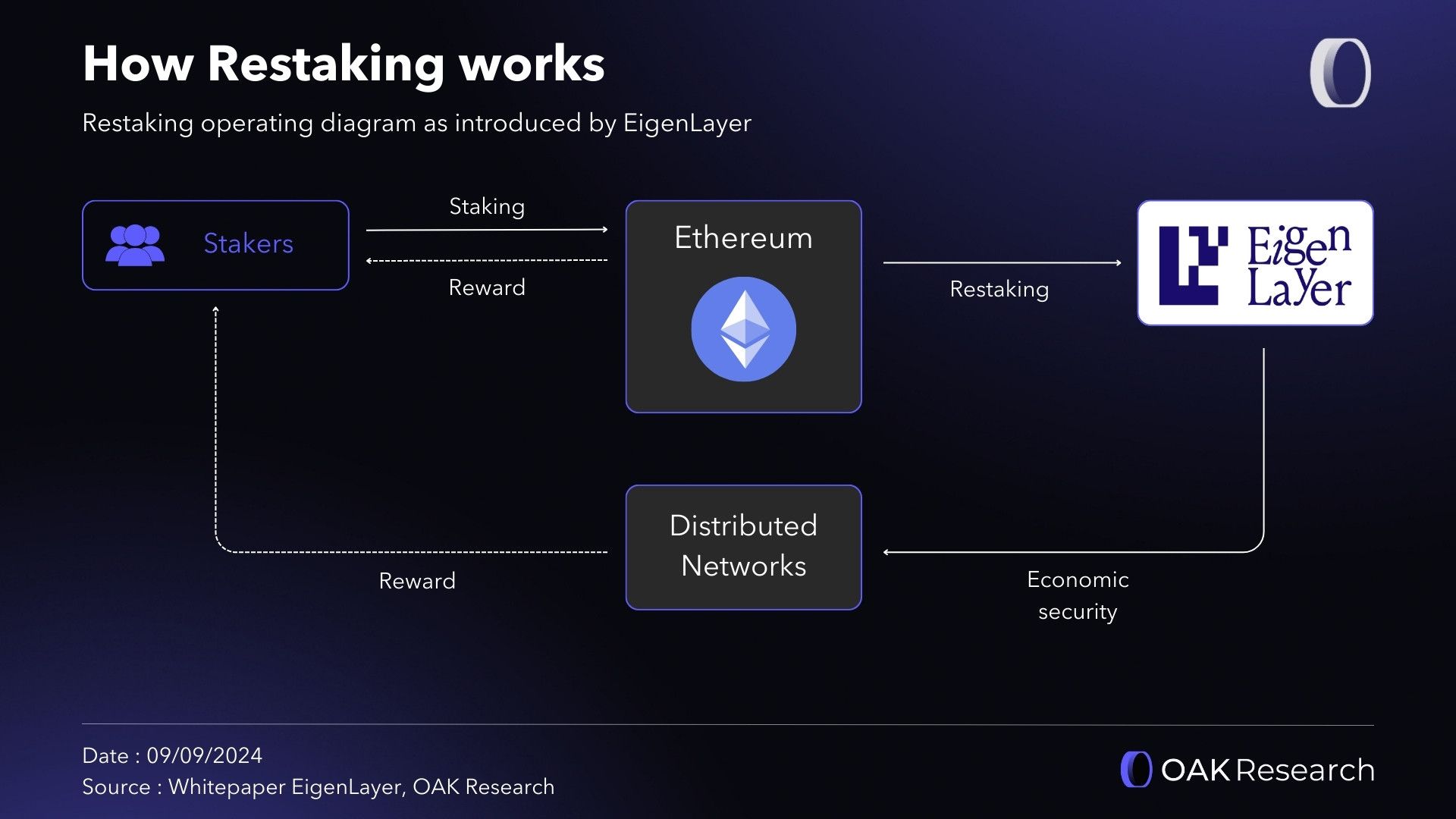
EigenLayer fundamentally redefines staking utility by introducing restaking, a mechanism that allows Ethereum validators to secure external services using their existing staked ETH. Unlike traditional staking, which solely protects Ethereum’s consensus, restaking deploys this capital to validate AVSs, inheriting Ethereum’s vast economic security pool. This shared model eliminates the need for nascent protocols to bootstrap independent validator sets, a process often plagued by high costs and slow adoption.
At its core, restaking operates through operators who opt into AVS duties, earning additional rewards while facing slashing risks for misbehavior. DataHaven exemplifies this: built on StorageHub, it separates storage from verification. Providers handle off-chain data persistence, while EigenLayer restakers cryptographically verify availability and integrity. This architecture ensures EigenLayer AVS verifiable storage scales efficiently, addressing a critical bottleneck in Web3 data management.
From a portfolio perspective, this innovation diversifies yield opportunities for stakers. Long-term restakers, incentivized by EigenLayer’s recent reward structures, now provide consistent security to services like DataHaven, mitigating short-term optimization pitfalls. Yet, balance remains key; while rewards multiply, correlated slashing risks across AVSs warrant careful exposure management.
DataHaven Emerges as a Verifiable Storage Powerhouse
DataHaven represents the next evolution in onchain storage, tailored for production-scale applications requiring tamper-proof data. Operating as an EVM-compatible Substrate chain secured by EigenLayer, it inherits Ethereum’s proof-of-stake economics. Providers store data off-chain, but restakers enforce verifiability through EigenLayer’s protocol, enabling seamless integration with Ethereum AVSs.
DataHaven extends this architecture as an AVS secured by EigenLayer’s ETH restaking protocol.
This DataHaven EigenLayer integration is particularly transformative for AI agents, which rely on persistent, auditable datasets for training, inference, and decision-making. Traditional decentralized storage solutions often falter under high-throughput demands or lack economic finality. DataHaven counters this by tapping restaking’s liquidity, ensuring data remains available even as usage surges.
Consider the mechanics: users submit data to StorageHub, where providers bid to store it. EigenLayer operators then attest to proofs of availability, slashing non-compliant actors. This creates a flywheel of security and usability, positioning DataHaven as a foundational layer for restaking secure compute Ethereum ecosystems.
Empowering AI Agents Through Restaking-Secured Infrastructure
AI agents on Ethereum AVSs demand more than raw compute; they require verifiable data pipelines immune to manipulation. Enter EigenLayer’s symbiosis with DataHaven, which furnishes precisely that. By securing storage via restaking, AI developers gain a trust-minimized backbone for agentic workflows, from autonomous trading bots to predictive analytics oracles.
Ethereum (ETH) Price Prediction 2027-2032
Outlook amid EigenLayer restaking, DataHaven AVS integration for AI agents, and Ethereum ecosystem growth
| Year | Minimum Price (USD) | Average Price (USD) | Maximum Price (USD) | YoY Change (Avg from Prior Year) |
|---|---|---|---|---|
| 2027 | $2,200 | $3,500 | $5,000 | +75% |
| 2028 | $3,000 | $5,000 | $8,000 | +43% |
| 2029 | $4,000 | $7,000 | $12,000 | +40% |
| 2030 | $5,500 | $10,000 | $16,000 | +43% |
| 2031 | $7,000 | $13,000 | $20,000 | +30% |
| 2032 | $9,000 | $16,500 | $25,000 | +27% |
Price Prediction Summary
Ethereum (ETH) is forecasted to experience strong growth from 2027 to 2032, driven by EigenLayer’s restaking protocol securing AVSs like DataHaven for verifiable AI agent storage. Starting from ~$2,000 in 2026, average prices could reach $16,500 by 2032 in a base case, with bullish maxima up to $25,000 amid adoption surges and bearish minima reflecting market cycles.
Key Factors Affecting Ethereum Price
- EigenLayer restaking expansion and AVS adoption, including DataHaven for decentralized storage
- Ethereum scalability upgrades (e.g., Dencun effects persisting) and L2 ecosystem growth
- AI-Web3 convergence boosting demand for verifiable computation and data services
- Regulatory developments favoring staking and DeFi
- Bitcoin halving cycles and macro risk-on sentiment
- Competition from Solana/L2s and potential economic downturns influencing min/max ranges
Disclaimer: Cryptocurrency price predictions are speculative and based on current market analysis.
Actual prices may vary significantly due to market volatility, regulatory changes, and other factors.
Always do your own research before making investment decisions.
This Ethereum restaking AI agents synergy amplifies EigenLayer’s utility beyond mere yield farming. Agents can now query DataHaven-stored datasets with cryptographic guarantees, fostering composability across AVSs. For investors, it’s a signal of maturation: restaking evolves from experimental primitive to enterprise-grade security, potentially capturing value as AI-Web3 convergence accelerates.
However, risks persist. Over-reliance on shared security could amplify systemic vulnerabilities if slashing events cascade. My view? Diversified restaking strategies, blending native ETH with LSTs, offer resilience while capturing upside. As ETH holds steady at $1,993.74, this partnership invites measured optimism for portfolios eyeing DeFi’s next phase.
Restakers opting into DataHaven’s AVS duties tap into a layered incentive structure. EigenLayer’s protocol distributes rewards from AVS emissions alongside Ethereum staking yields, with recent updates emphasizing long-term commitment through 4x multipliers for consistent operators. This aligns incentives, favoring reliable security over transient participation.
Economic Model: Incentives and Slashing Dynamics
The economic model underpinning this EigenLayer DataHaven partnership hinges on precise slashing mechanisms. Operators stake ETH or LSTs against DataHaven tasks, such as attesting to data availability proofs. Misbehavior, like failing to verify storage or colluding on false attestations, triggers penalties proportional to the infraction’s severity. This calibrated risk-reward calculus deters malice while rewarding diligence.
From a risk management standpoint, correlation remains the chief concern. A systemic event impacting multiple AVSs could propagate losses, yet DataHaven’s off-chain storage focus dilutes this somewhat; verification duties are discrete from consensus-level faults. Investors should monitor operator diversification metrics and AVS-specific total value locked (TVL), currently buoyed by Ethereum’s resilience at $1,993.74.
Key Benefits for AI Agents & Restakers
-
Ethereum-Level Security: DataHaven as an AVS inherits restaked ETH economic security from EigenLayer, extending Ethereum’s protection to verifiable storage without bootstrapping new validators.
-

Verifiable Storage: Enables trust-minimized, production-scale data storage and retrieval for AI agents on Ethereum AVSs, ensuring data integrity via on-chain verification.
-
Shared Security Efficiency: Leverages EigenLayer’s restaking model to share Ethereum’s validator set across AVSs, reducing costs and complexity for DataHaven operations.
-

Restaker Rewards: Long-term restakers earn additional yields by securing DataHaven alongside other AVSs, incentivized by EigenLayer’s protocol.
-

Decentralized Verification: Separates off-chain storage by providers from on-chain verification secured by EigenLayer, optimizing for AI data needs.
Slashing events, though rare thus far, serve as a market signal. Early incidents in other AVSs prompted operator upgrades and insurance protocols, foreshadowing maturity. DataHaven’s design, separating storage from verification, further compartmentalizes risks, allowing providers to scale capacity without proportional security overhead.
Navigating Risks in the Restaking Landscape
While the upside gleams, prudent allocation demands scrutiny. Liquidity constraints in LSTs, potential centralization among top operators, and oracle dependencies for DataHaven proofs warrant vigilance. My balanced take: allocate no more than 10-20% of a digital asset portfolio to restaking initially, scaling with proven track record.
Ethereum’s modest 24-hour uptick of and $60.06 reflects broader market poise amid these innovations. As restaking TVL climbs, expect volatility tied to AVS launches, but DataHaven’s verifiable storage niche positions it for steady adoption.
Portfolio diversification shines here. Pair DataHaven exposure with uncorrelated AVSs, blending native staking for base yield and restaking for alpha. Tools like operator dashboards reveal optimal strategies, ensuring resilience across cycles.
Outlook: Restaking’s Role in AI-Web3 Fusion
Looking ahead, this integration heralds a data-secure era for Ethereum restaking AI agents. AI agents, from DeFi yield optimizers to NFT curators, will leverage DataHaven’s proofs for autonomous execution, composable with other EigenLayer services like EigenDA for availability layers.
The flywheel accelerates: more agents drive storage demand, bolstering restaker rewards, which attracts deeper liquidity. Yet, regulatory scrutiny on AI-DeFi intersections looms; frameworks emphasizing transparency will favor cryptographically assured systems like this.
For blockchain professionals, DataHaven exemplifies AVS specialization. Its EVM compatibility invites Ethereum dApps to plug in seamlessly, expanding the EigenLayer AVS verifiable storage footprint. Investors tracking ETH at $1,993.74 should view this as incremental compounding, not moonshot speculation.
Ultimately, EigenLayer’s restaking, through partnerships like DataHaven, fortifies Ethereum’s moat. It transforms idle capital into productive security, nurturing an ecosystem where AI agents flourish amid verifiable abundance. Balanced positions here promise enduring value in DeFi’s maturing tapestry.
About the Author