
EigenLayer 2026 market snapshot
The EigenLayer ecosystem entered 2026 with a distinct shift in momentum. After a period of consolidation, the network saw a notable 20% rally in late May driven by a surge in transfer activity and renewed trader optimism. This breakout highlighted the growing demand for restaked assets, though the broader market remains cautious. As of late May 2026, EIGEN is trading around $0.22, reflecting a recent 6.5% pullback from its highs.
Technical indicators currently paint a bearish picture, with market sentiment scores in the "Fear" zone. This hesitation suggests that while the underlying network activity is strengthening, price discovery is still finding its footing. Investors are watching closely to see if this volatility stabilizes as more Active Verification Services (AVS) launch and integrate with DeFi liquidity pools.
Restaked AVS reshaping security
Active Validated Services (AVS) represent the practical application of restaked security, allowing developers to build new infrastructure without the prohibitive cost of launching independent validator sets. By tapping into Ethereum's existing staked ETH, these services leverage a shared security model that dramatically lowers the barrier to entry for new cryptographic networks.
This shift moves the industry away from isolated security silos. Instead of each new protocol needing to bootstrap its own expensive validator economy, AVSs can rent security from the Ethereum mainnet. This approach not only reduces the cost of capital for bootstrapping new services but also accelerates decentralization by pooling a larger, more diverse set of validators.
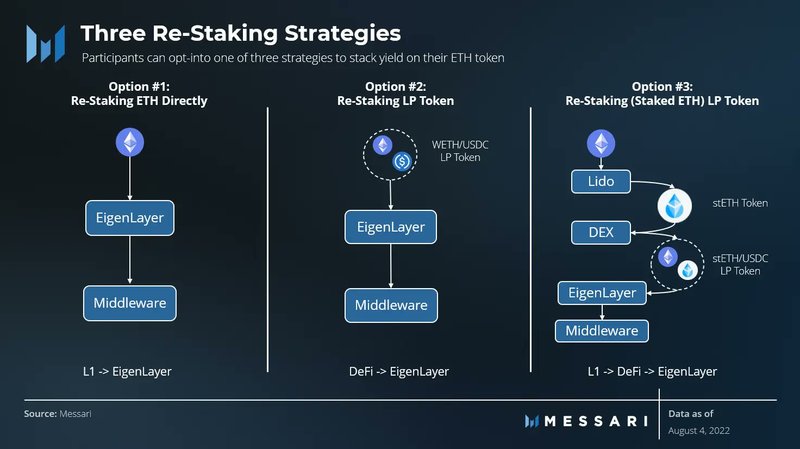
The implications for DeFi are significant. Protocols can now offer enhanced security guarantees or novel consensus mechanisms without waiting years to build a robust validator network. This efficiency allows the ecosystem to iterate faster, focusing resources on innovation rather than redundant security infrastructure.
As the AVS ecosystem matures, we are seeing a transition from simple token staking to complex, service-specific security requirements. This evolution ensures that the security provided is not just generic, but tailored to the specific threat models of the DeFi applications relying on it.
How Restaking Changes Yield and Liquidity
Restaking fundamentally alters the yield equation for liquidity providers by allowing the same capital to secure multiple services simultaneously. In the 2026 landscape, this dual-use model shifts capital efficiency from a linear to a multiplicative structure. Instead of earning a single staking reward, providers can layer additional yield from Active Verification Services (AVSs) on top of base Ethereum staking returns.
This efficiency gain comes with a distinct risk profile. While traditional staking offers predictable, albeit lower, yields, restaking introduces variable returns based on AVS demand and slashing conditions. The liquidity provider is no longer just betting on network security but also on the operational reliability of the specific AVSs they support. This dynamic creates a more complex yield curve where returns are less stable but potentially higher.
To understand the trade-offs, it helps to compare the mechanics of traditional staking against the restaking model. The table below outlines the key differences in yield generation and risk exposure.
| Feature | Traditional Staking | Restaking (EigenLayer) | Risk Profile |
|---|---|---|---|
| Capital Efficiency | Single Use | Multi-Use | Low |
| Yield Source | Base Block Rewards | Base + AVS Fees | Medium |
| Slashing Exposure | Network Protocol | Network + AVS Specific | High |
| Liquidity Type | Locked or Liquid Staking | Liquid Restaking Tokens (LRTs) | Medium |
The introduction of Liquid Restaking Tokens (LRTs) has further refined this liquidity dynamic. LRTs allow providers to maintain liquidity while participating in restaking, bridging the gap between capital efficiency and flexibility. This innovation ensures that liquidity providers are not forced to lock up assets for extended periods, a common constraint in traditional staking models. As the ecosystem matures, the interplay between LRT liquidity and AVS demand will likely dictate the primary yield opportunities for 2026.
Incentive structures and governance
EigenLayer is shifting its focus from passive restaking to active network participation through a new governance framework. The EigenLayer Foundation is proposing the creation of an Incentives Committee, a body designed to direct programmatic token rewards toward operators and restakers who actively support new Active Verification Services (AVS) [src-serp-3]. This structural change aims to solve the liquidity fragmentation problem by aligning economic incentives with network security needs.
The proposed committee will manage a dedicated treasury allocation, distributing rewards based on the performance and security contributions of specific AVSs. Rather than a blanket distribution, rewards will be targeted at services that require high throughput or specialized cryptographic verification. This mechanism ensures that capital flows to the most critical infrastructure components, encouraging operators to diversify their services rather than concentrating solely on legacy consensus layers.
Governance participation is becoming a prerequisite for maximizing yield. Restakers who engage in voting on incentive parameters and AVS security standards will likely see improved reward multipliers. This creates a feedback loop where active governance leads to better network health, which in turn supports higher token value. The shift marks a transition from a static staking model to a dynamic, service-oriented economy where participation is both a governance duty and a revenue driver.
EIGEN price outlook and risks
Use this section to make the EigenLayer decision easier to compare in real life, not just on paper. Start with the reader's actual constraint, then separate must-have requirements from details that are merely nice to have. A practical choice should survive normal use, maintenance, timing, and budget. If a recommendation only works in an ideal situation, call that out plainly and give the reader a fallback path.
The simplest way to use this section is to write down the must-have criteria first, then compare each option against those criteria before weighing nice-to-have features.
EigenLayer 2026 FAQ
The landscape for EigenLayer (EIGEN) in 2026 is defined by the maturation of Actively Validated Services (AVS) and the shifting dynamics of restaked liquidity. As the protocol moves from experimental phases to institutional-grade infrastructure, several key questions emerge regarding its trajectory and investment viability.
No comments yet. Be the first to share your thoughts!